
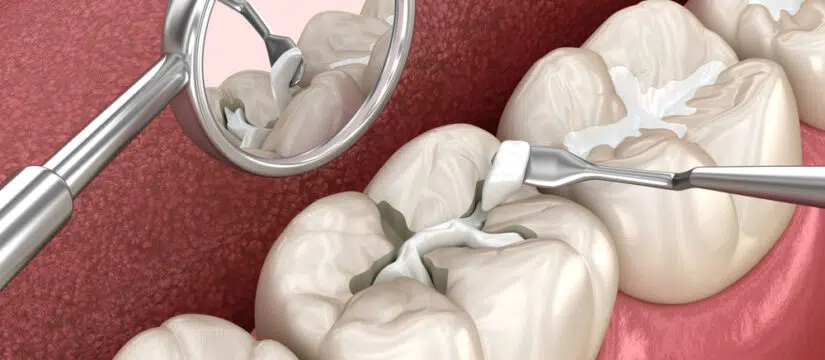
The cost of a tooth filling depends on the tooth, how much of it needs repairing and the material used. Because no two fillings are the same, we always check the tooth and give you a written quote before we start. Here is what drives the price, so you know what to expect.
Key points
- The price depends on how many tooth surfaces are filled, which tooth, the material and any X-rays needed.
- We give you a written quote with ADA item numbers before treatment.
- Fillings are usually claimable on extras cover; we claim on the spot with HICAPS.
- A small cavity treated early usually costs less than a larger repair later.
What affects the cost of a filling?
- How many surfaces are involved. A small filling on one surface costs less than one that wraps around two, three or more surfaces of the tooth.
- Which tooth it is. Back teeth (molars and premolars) take more chewing force and are often priced differently from front teeth.
- The material. Most fillings today are tooth-coloured composite resin. Larger repairs may need an inlay or onlay or a crown instead.
- Extra steps. An X-ray, a check-up or treatment of deep decay can add to the total.
How are fillings itemised?
Australian dentists use item numbers from the Australian Dental Association schedule. Composite fillings use the 52x item numbers for front teeth and 53x for back teeth, with the last digit showing how many surfaces are filled. Your quote will list these numbers, so you can ask your health fund exactly what you will get back.
Will my health fund cover a filling?
Fillings usually fall under general dental or “major” dental cover, depending on your fund and level of extras. We claim on the spot with HICAPS, so you only pay the gap on the day. See our fees page and no-gap dental options for more detail. Eligible children may also be covered under the Child Dental Benefits Schedule.
Why it pays to fill a cavity early
A small cavity is quicker and less costly to fix than one left to grow. Untreated decay can reach the nerve, which may mean root canal treatment or an extraction later. Regular check-ups help us find decay while it is still small.
Common questions
- How long does a filling take? Most take 30 to 60 minutes.
- Does it hurt? We use local anaesthetic so the tooth is numb during treatment. Some sensitivity afterwards is normal; see our guide to sensitivity after a filling.
- How long do composite fillings last? Many last for years with good care, though this varies with size, location and habits like grinding.
For an accurate price, book an exam and we will explain your options and costs before any treatment. Learn more about dental fillings at Glenmore Park.
Composite (white) fillings vs amalgam (silver) fillings
Most fillings placed today are tooth-coloured composite resin. Composite bonds to the tooth, blends in with your natural colour and often allows a more conservative preparation. Amalgam, the traditional silver filling, is still durable, but many patients prefer composite for appearance. We will explain which suits your tooth, its size and its position.
Signs you may need a filling
- Sensitivity to cold, hot or sweet foods in one tooth.
- A rough edge, hole or dark spot you can feel or see.
- Food catching between two teeth that did not used to trap food.
- A chipped tooth or a broken old filling.
Early decay often has no symptoms at all, which is why regular check-ups and X-rays are important.
Reviewed by the Glenmore Park Dental Services clinical team, October 2026. This article is general information, not personal dental advice.
To book, call Glenmore Park Dental Services on (02) 4733 1197 or request an appointment. We are at Shop 17b, 11 Town Terrace, Glenmore Park, and open Monday to Saturday.